
Smart Factory & Automation World 2026: Why This Is the Most Important Week in Korean Industrial Buying
Every March, something unusual happens in Seoul.
Tens of thousands of engineers, plant managers, and procurement leads from Korea’s most demanding industrial sectors walk the floors of COEX for three days evaluating, comparing, and making decisions that will shape their capital budgets for the next 12 to 18 months.
Smart Factory Automation World 2026 (AW) is not Korea’s version of a typical trade show. It is the single most concentrated moment of industrial buyer attention in the Korean calendar. For international companies in factory automation, robotics, IIoT, MES, or industrial software, it represents something specific: a window into how this market actually works and whether your product fits into it.
With a background spanning industrial sectors and several years focused on B2B market entry for automation and manufacturing companies, we view AW not simply as an exhibition, but as a strategic checkpoint in Korea’s annual procurement cycle. What happens on those three days, and more importantly what companies do before and after, often determines whether a foreign vendor builds real pipeline in Korea or spends another year trying to figure out why the market is not responding.
AW 2026 runs March 4–6, 2026 at COEX Convention Center in Seoul.
The Show at a Glance: Smart Factory Automation World 2026
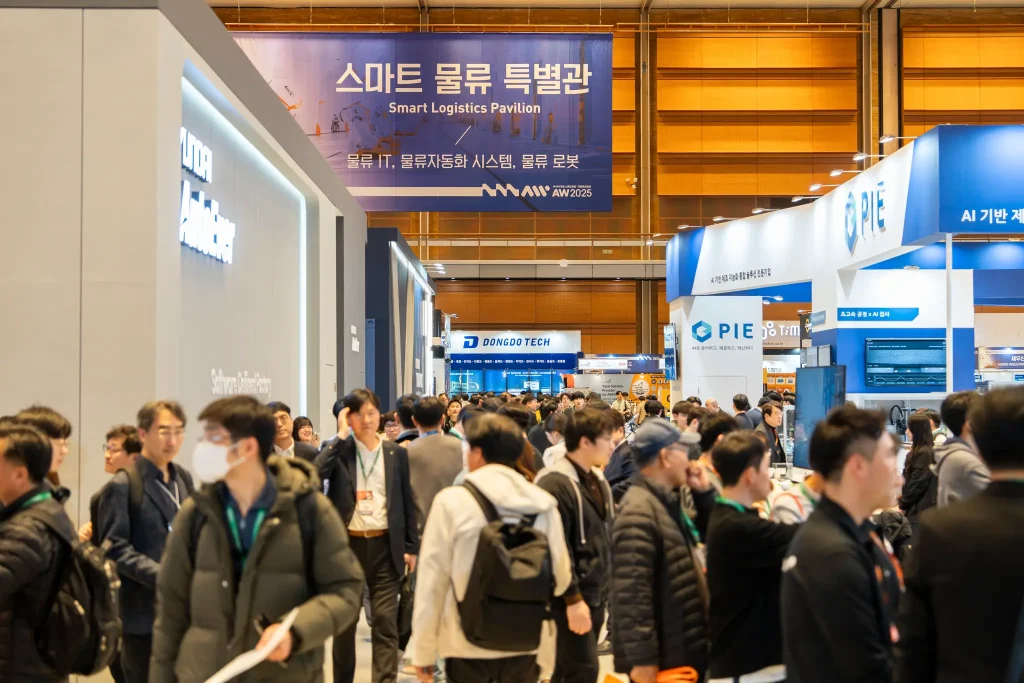
AW has been running since 1990, making it Asia’s longest-running factory automation exhibition and the anchor event of Korea’s smart factory exhibition calendar. The 2025 edition drew 70,000 visitors from 500 companies across 22 countries a 15% increase in visitors and 10% increase in exhibitors compared to the previous year. The show also generated USD 106 million in estimated export agreements through its KITA-organized overseas buyer consultation program, which facilitated 317 business meetings between international buyers and 134 Korean domestic companies. You can find the full event overview on the official Smart Factory Automation World website (https://www.automationworld.co.kr).
The show is structured across three sub-exhibitions:
aimex
FA hardware including sensors, PLCs, DCS, motion control, drives, and automation components.
Korea Vision Show
Machine vision including industrial cameras, lenses, lighting, and image processing software.
Smart Factory Expo
The software and systems layer including AI, big data, cloud, MES, ERP, IIoT, industrial robotics, and smart logistics.
Alongside the exhibition floor, AW runs professional sessions including the Industrial Digital Transformation Conference, a CEO Summit, and KITA-organized 1:1 business matching for international companies.
The visitor profile is almost entirely professional. The people walking those halls hold titles like production engineering manager, automation team lead, and procurement director. Many are running active vendor evaluations.
Why Korea’s Smart Factory Market Is at an Inflection Point Right Now
Understanding AW requires understanding what is happening in Korean manufacturing right now because the show is a direct reflection of pressures that have been building in the Korean industrial economy for years.
Government Investment Is Accelerating
Korea’s government has dramatically accelerated its smart factory investment. The Ministry of SMEs and Startups (MSS) submitted a 2026 budget for smart factory adoption and upgrades of KRW 402 billion (approximately USD 275 million) a 70% increase over 2025. Separately, the ICT-Converged Smart Factory Expansion Program received an allocation of KRW 436.56 billion, nearly double its previous year funding. This is real procurement budget that Korean manufacturers are actively deploying against qualified solutions.
Labor Costs Are Forcing the Automation Conversation
Korea’s minimum wage reached KRW 10,320 per hour in 2026, having risen from KRW 6,030 in 2016 a 71% increase over a decade. For Korea’s mid-sized manufacturers the “junggyeon” companies that form the backbone of the country’s supply chains the automation ROI conversation has shifted from “should we?” to “what do we automate first, and with whose technology?”
Supply Chain Diversification Is Opening Doors for Foreign Vendors
Korea’s key industrial sectors including semiconductors, EV batteries, and automotive are actively diversifying their technology supplier base. Korean conglomerates and their Tier 1 and Tier 2 suppliers are more open to evaluating non-domestic, non-Japanese automation solutions than they were even three years ago. This is a structural shift driven by supply chain risk management, creating real entry points for foreign vendors that understand how to position themselves correctly.
These three forces government budget expansion, labor cost pressure, and supply chain diversification are converging simultaneously. That is why the timing of Korea market entry for industrial automation companies matters more right now than it typically would.
What Korea’s Industrial Automation Trade Show Actually Tells You About the Market
Most international companies approach Smart Factory Automation World 2026 as a visibility opportunity. Show up, meet buyers, collect contacts. That framing is not wrong, but it misses what the event is actually useful for.
AW is a real-time signal about Korean industrial buying priorities. The sections that draw the most floor traffic, the sessions that sell out, the categories where Korean buyers cluster and compare these tell you more about where procurement decisions are heading than any market research report.
In 2025, the show’s theme was “Automation to Autonomy,” and the heaviest attention went to AI-integrated manufacturing systems, autonomous mobile robots, and MES platforms that could connect to Korea’s dominant ERP environments. Machine vision saw significant growth, driven in part by EV battery quality control requirements in the automotive supply chain. Boston Dynamics’ logistics robot “Stretch” made its Asian debut at the 2025 show, drawing sustained attention from Korean industrial buyers.
If your product plays in any of these categories, the buyers are there. The question is whether you are positioned for them in a way that Korean procurement teams can actually evaluate.
In Part 2, we will cover the specific mistakes international companies make when they engage with AW and the Korean industrial market and what a smarter approach actually looks like.
We are available for a limited number of in-person strategy discussions at Automation World Seoul this year. If you are evaluating Korea as a growth market for your industrial or automation solution, feel free to connect in advance to schedule a time: https://linkoreamarketing.com/contact/